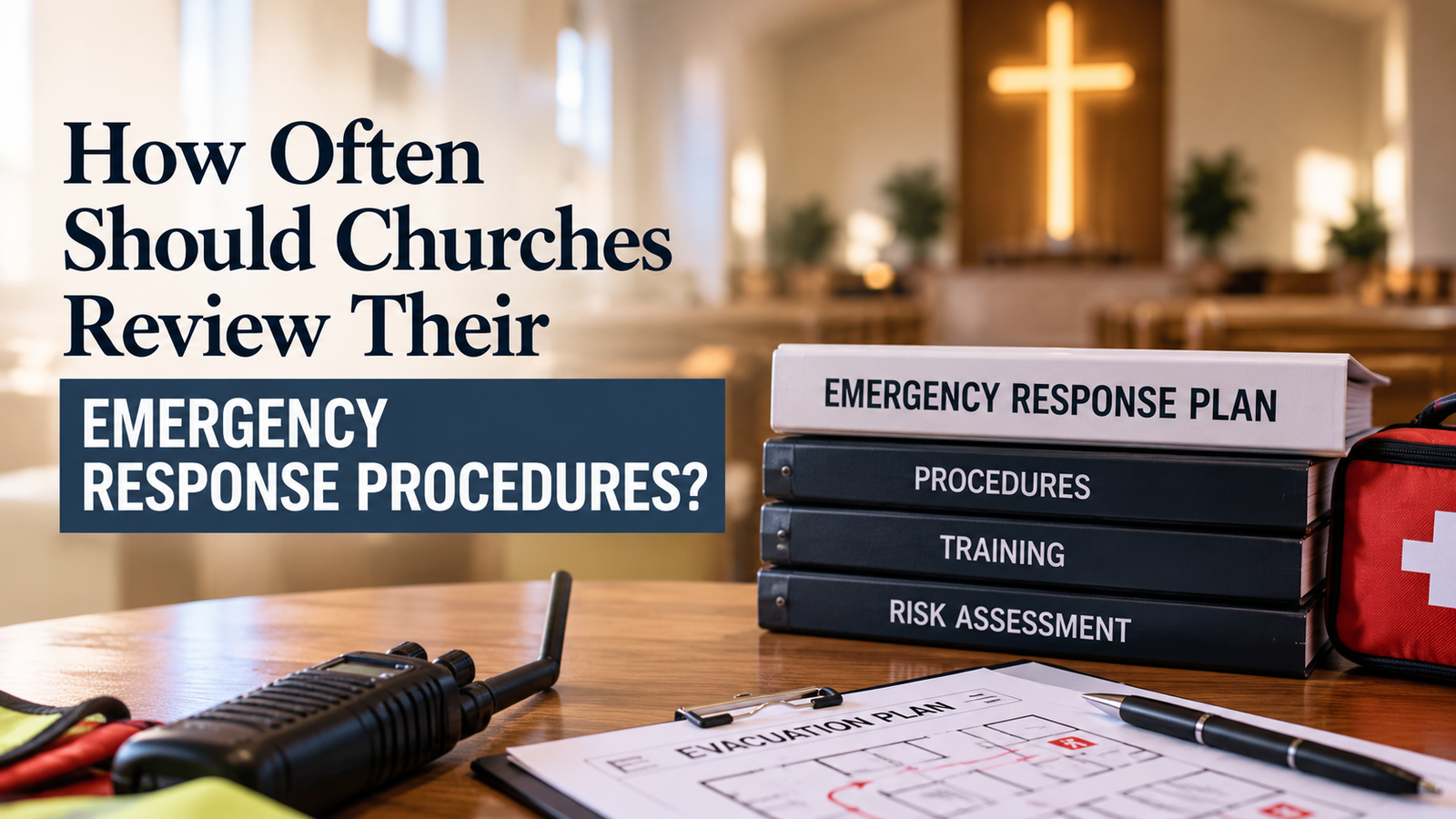
As a general best practice, churches should conduct a comprehensive review of their emergency response procedures at least once per year, with additional evaluations throughout the year.
However, annual reviews alone may not be sufficient for every congregation. Larger churches, facilities with multiple buildings, and organizations operating childcare programs or hosting frequent public events may benefit from more frequent assessments.
A practical review schedule might include:
-
Monthly: Check emergency equipment, contact information, and immediate safety concerns.
-
Quarterly: Review selected procedures, conduct staff discussions, and evaluate training needs.
-
Annually: Complete a comprehensive review of the church’s emergency action plan, security procedures, and overall preparedness.
-
After significant changes or incidents: Update procedures whenever facilities, personnel, operations, or identified risks change.
These intervals are general planning recommendations rather than universal legal requirements. Applicable regulations, insurance policies, childcare licensing standards, and local fire codes may establish additional obligations.
The goal is to establish a consistent process that keeps emergency preparedness relevant and effective.
Why Emergency Response Procedures Need Regular Updates
Even a well-written emergency action plan can lose its effectiveness over time.
Churches are dynamic organizations. New families join, staff members transition into different roles, ministries expand, and building layouts change. Each of these developments can affect how an emergency should be handled.
For example, a church may create an evacuation plan based on its original sanctuary and classroom arrangement. Several years later, the congregation may add a fellowship hall, expand its children’s ministry, or renovate existing spaces.
If the emergency plan has not been updated, evacuation routes, designated assembly areas, and communication procedures may no longer reflect the property’s current layout.
Personnel changes can create similar problems. A volunteer responsible for contacting emergency services may leave the church, while newly appointed ministry leaders may never receive training on established procedures.
Regular reviews help identify these gaps before they become serious concerns.
1. Review Emergency Procedures After Changes to Church Facilities
Building modifications are one of the most important reasons to revisit church emergency response procedures.
Renovations, expansions, new entrances, changes to parking areas, and the addition of classrooms can all influence how individuals move throughout a property during an emergency.
Church leadership should evaluate whether existing evacuation routes remain accessible and whether designated assembly locations are still appropriate.
Additional considerations may include emergency lighting, exit signage, fire protection equipment, accessibility, and communication between separate buildings.
Even relatively minor changes can affect emergency planning.
For instance, converting a storage room into a children’s classroom may increase occupancy in an area that previously received little attention during evacuation planning.
Whenever a church makes significant facility changes, its emergency procedures should be reviewed to ensure they continue to reflect actual conditions.
2. Evaluate Emergency Plans When Leadership or Volunteers Change
Many churches depend heavily on volunteers to support worship services, children’s ministries, hospitality programs, and security operations.
Although volunteers play an essential role, changes in personnel can create gaps in emergency preparedness.
An emergency response plan may identify specific individuals responsible for coordinating evacuations, contacting authorities, or assisting congregants with mobility limitations.
If those individuals are no longer available, their responsibilities must be reassigned.
Churches should review emergency roles whenever significant leadership or volunteer changes occur.
New personnel should receive appropriate orientation and training before assuming responsibilities related to emergency response.
It is also important to designate backup personnel for critical functions.
A church should never depend entirely on one individual being present to carry out an essential emergency procedure.
3. Conduct Quarterly Emergency Preparedness Reviews
Quarterly reviews provide an opportunity to examine specific aspects of emergency preparedness without requiring a complete reassessment every few months.
During these reviews, church leadership and designated safety personnel can discuss potential scenarios, evaluate current procedures, and identify areas needing improvement.
For example, one quarterly review might focus on medical emergencies, including the location of first aid supplies, AED availability, and procedures for contacting emergency medical services.
Another review might examine severe weather preparedness, including shelter locations and communication procedures.
Additional discussions could address fire evacuations, suspicious activity, missing children, or emergency coordination during special events.
Quarterly reviews also provide opportunities to evaluate volunteer readiness and identify training needs.
By addressing individual topics throughout the year, churches can maintain consistent attention to preparedness without overwhelming staff and volunteers.
4. Schedule Annual Church Security Risk Assessments
While internal reviews are valuable, churches can also benefit from periodic professional security risk assessments.
A security risk assessment examines the church’s physical environment, existing safety procedures, operational practices, and potential vulnerabilities.
Depending on the facility and scope of the assessment, a qualified security consultant may evaluate entrances and exits, parking areas, exterior lighting, access control, emergency communication capabilities, and existing emergency response documentation.
The assessment should also consider the church’s regular activities and congregation characteristics.
A church operating a weekday preschool, for example, may face different planning considerations than one that primarily hosts weekend services.
Professional assessments can help church leadership identify concerns that may not be immediately apparent during routine internal evaluations.
An annual security risk assessment can serve as a valuable foundation for updating emergency action plans and prioritizing safety improvements.
Additional assessments may be appropriate following major renovations, operational changes, or significant security incidents.
5. Review Emergency Procedures After Every Significant Incident
An emergency does not have to result in injuries or property damage to provide valuable lessons.
Near misses, unexpected evacuations, medical emergencies, security concerns, and communication failures can reveal weaknesses in existing procedures.
Following a significant incident, church leadership should conduct an organized review of what occurred and how personnel responded.
The purpose should be to identify opportunities for improvement rather than assign unnecessary blame.
Questions may include whether emergency procedures were followed, whether responsibilities were clearly understood, and whether communication systems worked as expected.
Church leaders should also consider whether staff and volunteers had access to the resources they needed.
Findings from these discussions can be used to update emergency action plans, revise standard operating procedures, and improve future training.
When an incident involves law enforcement, emergency responders, or an ongoing investigation, churches should coordinate appropriately before conducting detailed internal reviews.
6. Keep Children’s Ministry Emergency Procedures Current
Children’s ministries deserve particular attention during emergency preparedness reviews.
Nurseries, Sunday school classrooms, youth programs, and weekday childcare operations often involve separate rooms, dedicated volunteers, and specific supervision requirements.
Emergency procedures should clearly explain how children will be accounted for, how staff will communicate with church leadership, and how reunification with authorized parents or guardians will occur.
Churches should also consider how procedures will function during different activities and attendance levels.
For example, an evacuation during a Sunday morning service may involve significantly more children and volunteers than a small Wednesday evening program.
Children’s ministry procedures should be reviewed whenever classroom assignments, staffing arrangements, enrollment levels, or building layouts change.
Periodic training can help ensure volunteers understand their responsibilities and know how to respond without creating unnecessary confusion.
7. Test Emergency Communication Systems Regularly
Effective communication is essential during emergencies.
Churches may rely on public address systems, handheld radios, mobile phones, emergency notification platforms, or designated staff members to communicate important information.
However, communication equipment and procedures must be evaluated periodically to ensure they remain reliable.
Contact lists can become outdated as staff members and volunteers change. Equipment may develop technical problems, and communication methods that work during regular operations may be less effective during a crowded event.
Church leadership should periodically verify emergency contact information, inspect communication equipment, and evaluate how instructions would be delivered throughout the property.
Special attention should be given to areas where communication may be difficult, including separate buildings, outdoor gathering spaces, and children’s classrooms.
Testing communication procedures during planned exercises can help identify problems before an actual emergency occurs.
8. Practice Emergency Response Through Training and Drills
An emergency action plan is only effective when the people responsible for implementing it understand what to do.
Regular training helps staff, ministry leaders, ushers, greeters, and designated security volunteers become familiar with emergency procedures.
Training may include reviewing evacuation routes, understanding emergency notification responsibilities, recognizing potential hazards, and learning how to assist individuals who require additional support.
Churches can also conduct tabletop exercises, which allow leadership teams to discuss hypothetical emergency scenarios in a controlled environment.
For example, a tabletop exercise might examine how the church would respond if severe weather developed during a large worship service.
Participants can discuss who would make decisions, how instructions would be communicated, and where congregants would seek shelter.
Practical drills may also be appropriate, depending on the type of emergency, congregation characteristics, and applicable safety requirements.
These exercises should be carefully planned to avoid unnecessary alarm, particularly when children or vulnerable individuals are involved.
9. Update Emergency Plans for Special Events and Seasonal Activities
Churches frequently host events that differ significantly from their normal weekly activities.
Holiday services, vacation Bible school, concerts, conferences, festivals, and community outreach programs can attract larger crowds and introduce additional operational challenges.
An emergency plan designed for a typical Sunday service may not fully address the needs of an event involving hundreds of additional visitors.
Before major events, church leadership should evaluate expected attendance, available parking, building capacity, emergency access, volunteer assignments, and communication procedures.
Outdoor events may require additional consideration for weather conditions and temporary structures.
Event-specific planning helps churches adapt their established emergency procedures to different circumstances while maintaining a consistent approach to safety.
10. Consider Ongoing Church Security Consulting
Maintaining effective emergency procedures can be challenging for churches with limited administrative staff or volunteer resources.
Leadership teams already manage worship services, ministries, finances, facilities, and community programs. Emergency preparedness can sometimes receive less attention than it deserves.
Ongoing security consulting can help churches establish a structured approach to reviewing procedures and maintaining documentation.
Rather than waiting several years between assessments, churches can work with a professional consultant to evaluate changing risks, update emergency action plans, review standard operating procedures, and identify training opportunities.
This ongoing relationship can be particularly valuable for growing congregations or churches operating multiple facilities.
Consistent professional guidance helps ensure emergency preparedness remains an active part of church operations.
How Watchman Security Risk Group Can Help
At Watchman Security Risk Group, we understand that churches want to provide a safe environment without compromising their welcoming atmosphere.
Our focus is helping organizations take a proactive, practical approach to security planning and emergency preparedness.
Through security risk assessments, customized emergency action plans, standard operating procedure development, and ongoing consultation, Watchman Security Risk Group helps churches identify vulnerabilities and establish clear procedures for responding to unexpected situations.
Whether your church needs to develop its first emergency response plan, review outdated procedures, or establish a consistent preparedness program, professional guidance can help leadership make informed decisions.
Emergency planning should reflect the unique needs of your congregation, facilities, ministries, and volunteers.
Make Church Emergency Preparedness an Ongoing Priority
So, how often should churches review their emergency response procedures?
At a minimum, churches should consider a comprehensive annual review, supported by quarterly evaluations and additional updates whenever significant changes or incidents occur.
Emergency preparedness is not simply about maintaining a document. It is about making sure the people responsible for protecting your congregation understand their roles and have the information necessary to respond appropriately.
Regular reviews, ongoing training, and professional security assessments can help churches maintain safer, more prepared environments.
Watchman Security Risk Group is ready to help your church strengthen its emergency preparedness strategy.
Visit watchmansecurityriskgroup.com to learn more about professional security risk assessments, emergency action planning, and ongoing security consulting services.